
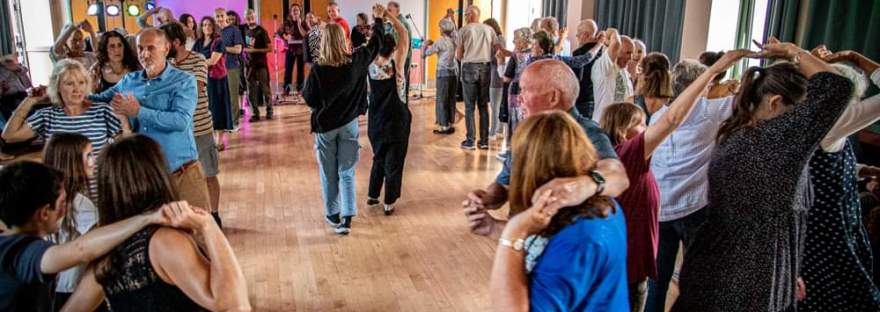
Wow, thank you so much to everyone who came along on the 12th September. It was fantastic to see so many people having fun!
Here are some notes from the class, in case you want any refreshers, or haven’t been along and are wondering what we get up to 🙂
In class one of our autumn term we covered a brief introduction to travelling steps (forwards skip change step and sideways slip step), by way of two set dances – Dhoon Jig and Boston Tea Party – and we danced the Canadian Barn Dance as a reminder of a ceilidh classic that we’d had a go of in workshops during the summer.
Dhoon Jig
The Dhoon Jig (4 couples, but can be more or less; music 32 bar jig; author Jessie Hamilton) is a Scottish country dance more than a classic ceilidh dance, but it is simple and lots of fun, and we think it should become a ceilidh fixture. In terms of moves, it gives you a chance to practice side steps (slip steps), forward travelling steps (skip change steps) – but you can also just relax, have fun and ‘walk’ the steps if you prefer – and casting. The key thing to be able to do in this dance is to be able to differentiate between your right and left!
Boston Tea Party
Another longways set dance that we learned was an English ceilidh dance, the Boston Tea Party (5 – but can be more or less; music 32 bar jig or reel, author Jean Butler). This one also gives plenty opportunities to use travelling steps as the top-couple gallop down the set, over the top of both lines and up the set again, casting, plus some fun with arches, dipping and diving!
Canadian Barn Dance
This was a bit of a reminder for anyone who has come along to a previous Ceilidh Cornwall workshop or ceilidh evening. We love to do the Canadian Barn Dance to songs! It is a couple dance, danced in a large anti-clockwise round-the room layout. Half the length of most set-dances, it is very quick to learn, a ceilidh classic and one of our favourites.
Looking forward to seeing everyone at more classes in the future.
Glossary
Cast / casting: Usually in longways sets, dancers dance to the outside of the set and move to another position – often to the end of the set farthest from the band, but sometimes to intermediate positions. See the Dhoon Jig video where the top couple casts one place down, meets in the middle of the set between the two lines, dances back up to the top, then casts to the bottom of the set.
Gallop: Couple joins hands and dance with slip steps / side steps usually down the middle of a longways set, as in the Boston Tea Party.
Longways (or longwise) set: two lines of dancers usually arranged down the room (usually the ‘top’ of the set nearest the band/music and the lines running away from the band, but orientation of the set sometimes depends on the shape of the room). Couples face each other, one in each line. Traditionally, when facing the band/music, the line on the left is men and the line on the right is women, but in Ceilidh Cornwall classes we don’t bother so much about this, because all dances can be danced with people of any gender in any position.
A set: a group of people arranged to dance together.
Slip step: A simple side step (step to the side, place feet together, step the side, feet together etc), often used in circling moves, used at the start of The Dhoon Jig and in gallops in the Boston Tea Party.
Top couple: The pair of dancers closest to the band/music.
Travelling step (skip change step): A step used to travel forwards rather than sideways. You can also walk these bits, which many people do in ceilidhs – but using this travelling steps makes it feel more ‘dancey’ or flowing. Best demonstrated in this video (complete with classic accordion cord at the start!), rather than using words:
 Ceilidh Cornwall