

Class 2 of our autumn term ceilidh classes involved spins and turns. There are so many ways to spin, swing and turn your partner in ceilidh-ish dancing, so we just looked at a few.
Strip the Willow (original) / Drops of Brandy
Strip the Willow is danced in a longways set and is all about spins!
To start the dance the active dancing couple use a two handed turn, sometimes called birling at the top of set and then repeat this whenever they are at the bottom or top of the set again (see videos below to see what I mean).
Crossed hands turn – a variation of the above, but not quite so stable, is to hold crossed arms – right hand in right hand, left hand in left hand, without the elbow grip. This is most common when just doing a single turn or not dancing fast. You’ll find this is often used in ceilidhs, and it particularly flows nicely into a promenade hold because you can keep holding hands and stand side by side and are conveniently in the right position to promenade (see Borrowdale Exchange and Glossary, below)
There are several options for the single handed turns used in the rest of the dance:
Here’s how this all looks put together in the Strip the Willow dance:
You can see the flow of the dancers and how the active dancers dance down and up along the lines of the set in this video:
Commonly at a ceilidh the dance might end with an Orcadian Strip the Willow, essentially the second half of the normal Strip the Willow, danced in a very long longways set, and with top couples starting sequentially so that multiple couples will move down the set at the same time. At wedding and party ceilidhs the Orcadian Strip the Willow is our most requested dance.
Borrowdale Exchange / Sextet Mixer
Our next dance to learn was Borrowdale Exchange. This dance has variations, and the one I taught has turns by the right hand with your partner, and left hand with your neighbour, to give us a chance to practice turns more. Most also involve a single turn or do-si-do.
The key move in Borrowdale Exchange is an unusual right hand star where you hold hands only with the person directly opposite you, and then separate out into couples with this new partner, then find a new set. The key to keeping to time we found is promptly reaching out to your opposite then counting to 8 for the right hand star before separating.
There are several ways to make right hand or left hand stars, sometimes also called teapots, wheels and right or left ‘hands across’. The types of hold vary between dance origin, in ceilidh most often People just pile their hands into a heap in the middle of the star and walk to turn the star or wheel. Sometimes all hold hands, sometimes dancers just hold hands with their opposite as in Borrowdale Exchange. Don’t worry about this, just be aware when dancing with others you might come across variations.
Pat-a-cake Polka (progressive version)
For a bit of light relief and an easy dance to learn, we ended on a couple/pair dance.
You’ll also find this called Heel Toe Polka, and lots of different spellings and variations of Pat-a-cake.
Fancy a flourish?
The Tulloch Turn is one of my favourite variations, suitable for any turn where you have a bit of time, such as the 16 beat turn at the start and end of Strip the Willow. It looks fancy and is fun! Unless both dancers know what to do then it can end up with some awkward fumbling at the start, in which case it is probably better to go for something simpler! A quick conflab before the start of Strip the Willow with your partner to decide on how to turn is a good idea.
Enjoy swings, spins and turns? Then take a look at John & Karen Sweeney’s Contra Fusion site to go down a rabbit-hole of 20 different ways to swing (and more), not including the ones we have covered! The Contra term ‘buzz-step’ referred to in these pages is closest to how we position feet in the two-hand turns to scoot around. But beware if you tend to want to learn all the details and could overwhelmed this is not something to worry about – the point of dancing is to have fun! Next time you’re at a ceilidh or barn dance look around – you’ll see lots of different swing and turning styles being used, especially by those who are experienced folk dancers. Ceilidh is very relaxed, all are welcome, with and without flourishes!
How to avoid getting dizzy
Eye contact is the key here: look into your partner’s eyes as you spin. This helps to keep a connection while dancing and it also reduces the dizziness factor.
Alternatives to spinning
Spinning isn’t for everyone! It is a bit tricky in Strip the Willow since it is almost entirely spinning, but in many dances where a spin, turn or swing is the normal way to do the dance you can substitute this with a gentler, slower turn just once around and back to place, or a Do-si-do. Do-si-do works particularly well, since it still involves you moving around you partner but there is no turning around, so you can’t get dizzy or feel unstable. You can also step-hop around in ballroom hold, as in most old time dances (e.g. Canadian Barn Dance).
Glossary
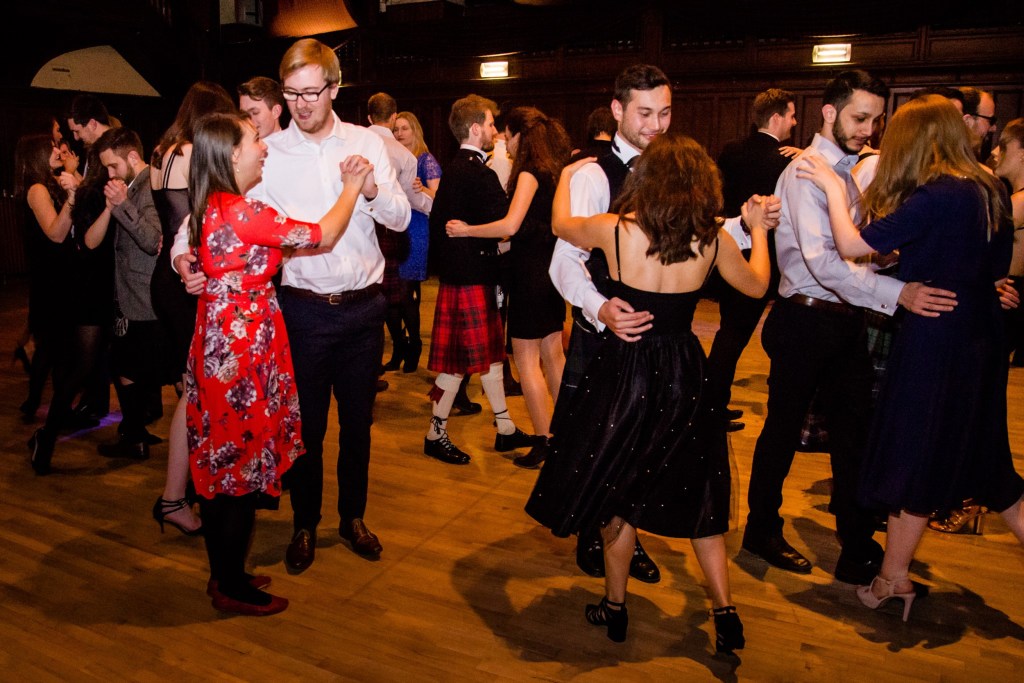
Ballroom hold – best illustrated with a photo:
Do-si-do – sometimes called back to back, or with various different spellings – dancers walk little clockwise circles around their partners, passing right shoulders first:
- dancers advance and pass right shoulders,
- without turning each dancer moves to the right passing in back of the other dancer. At this moment the partners face away from each other,
- then moving backwards dancers pass left shoulders returning to starting position.
Sometimes you’ll see various arm crossing arrangements – they aren’t necessary.
See-saw – the same as do si do but danced the other way around, anticlockwise, passing left shoulders first. Not common in ceilidh dancing.
Promenade hold – Crossed arms in front, usually right hands above left hands. Walking/dancing side by side.
Strip the Willow – the action of alternatively turning your partner and the dancers in the line of a set is called ‘Strip the Willow’ and is a figure used in other dances too. The key rule to remember is that you turn your partner by your right arm and people in the line by your left arm.
Pat-a-cake – you may remember this from playground games, a sequence of 8 beats with accompanying claps (for example: right hands together, left hands together, knees, both hands together). Or you can improvise for 8 beats.
Progressive – a progressive dance means that there is a move at the end of every repeat that moves you on to dance with another partner.
 Ceilidh Cornwall