Our final class before Christmas! How lovely to have met so many friendly people this term, thanks so much for coming along to our ceilidh classes. It has been a real pleasure to see you develop your ceilidh skills and to see all your smiling faces!
So, in our final class we went over a few dances we had done before, and then we learned a couple of new ones:
Nina’s Double Troika
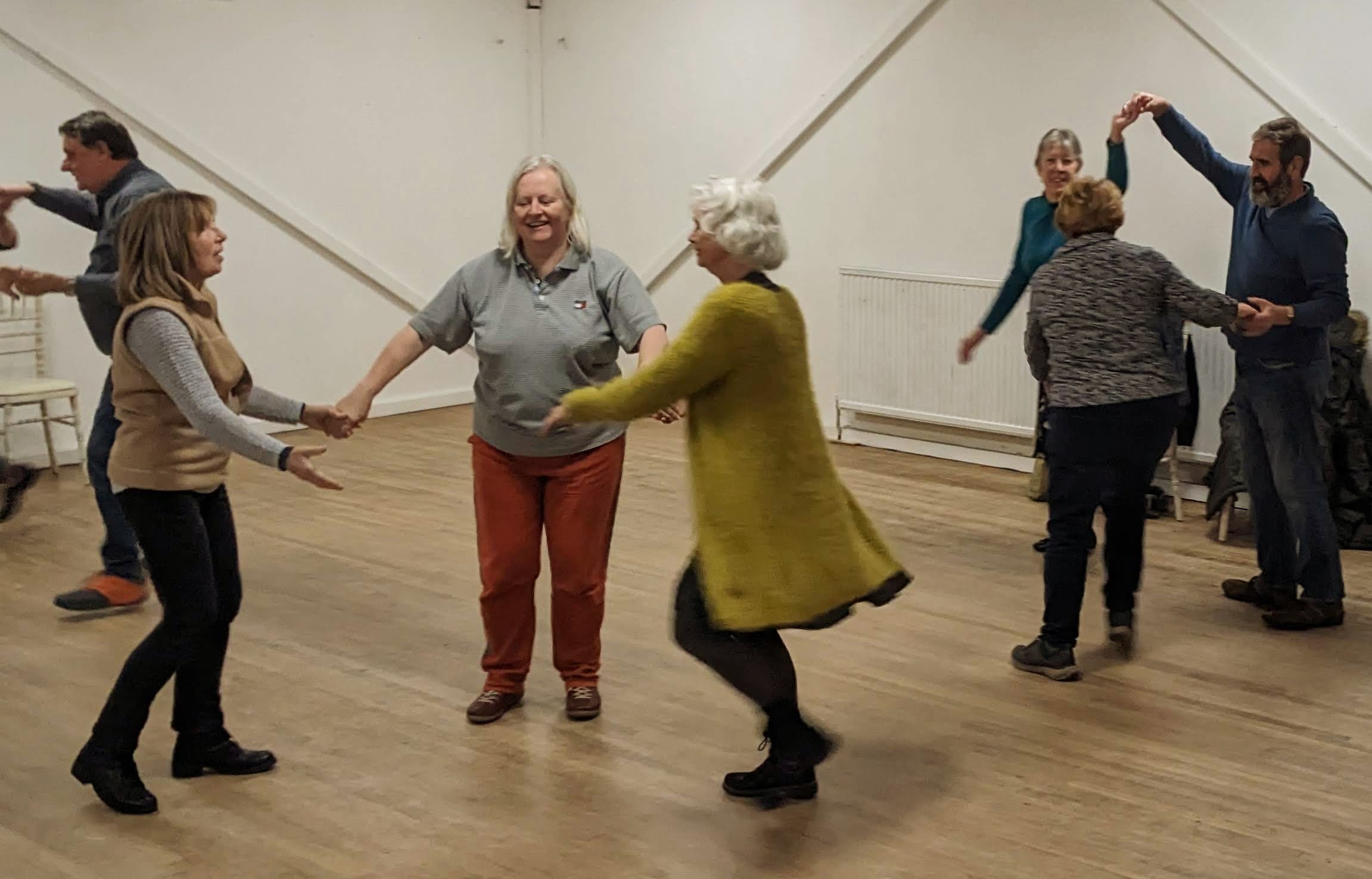
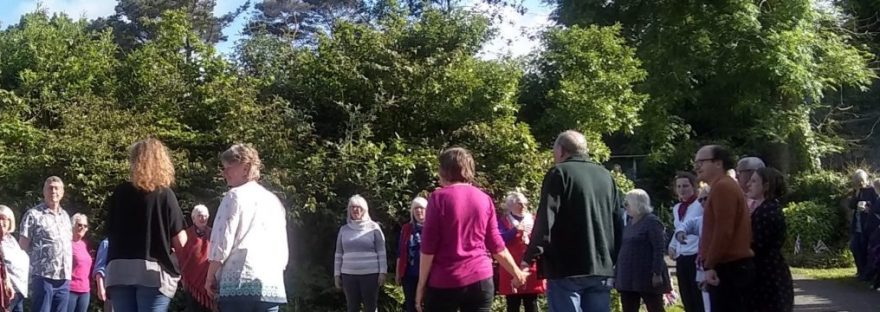
Learning Nina’s Double Troika at our ceilidh classes
Nina Fenner is also a ceilidh caller with The Rosevilles Ceilidh Band and she will be calling a few dances at our Christmas-ish Ceilidh on Friday 8th December so we learned a dance that she created.
Danced in groups of 3, it is a bit unusual in that each figure takes 4 beats rather than the more common 8. So, at times you might have to move fast. It can be danced to jigs and reels. Here are the instructions:
3 people in a circle. Circle left for 4. Then right for 4.
Break the circle into a line with joined hands. You’ll do this a few times in the dance and it is easiest if you keep in the same order in your three, but if you wish to have more of a challenge then you can vary who takes each place in the line by breaking the circle at different point each time through.
The middle person raises their hands. The person on the right hand end of the line dances first, turning anticlockwise towards the middle person and under the nearest arch to them. This takes 4 beats.
The person on the left hand end of the line now does the same through the arch nearest to them. Again, 4 beats.
Reform the circle. Circle left for 4 and right for 4.
Break the circle into a line again as before with joined hands.
The middle person raises their arms again into arches. The person on the right hand end of the line dances first, passing in front of the middle person and through the arch further away from them. The middle person will also need to turn on the spot. Hold hands loosely so you don’t get into a tangle. This move also takes 4 beats and you need to be faster than before.
The person on the left hand end of the line now does the same, passing in front of the middle person and through the arch farthest from them. The middle person turns on the spot. 4 beats.
Back to the start of the dance.
Clopton Bridge (ceilidh style)
Longways set for 4 couples (though we also managed with five couples and an extra pointy star). 32 bar hornpipe or jig as we did. This English ceilidh dance was written by John Chapman and published in 1987.
This was fun, and a gentler introduction to ‘corners’ than our previous attempt at the Reel of the 51st Division! I do like the unusual figure of first corners turning each other in the middle of the dance and then second corners doing this next.
Generally this dance is done to a hornpipe with step-hop footwork (see any video of Clopton Bridge, and below). To be more ceilidh-ish and suitable for events where there are ceilidh beginners we danced this with simple travelling steps and to a jig.
Clearly shows where dancers go, though rather a lot of ‘step-hop’ instructions!
Lisa Heywood describes a variation for advanced dancers where the end couples do rights and lefts around the outside of the set while the middle couples dance right and left hand stars. It is fun, but requires fast movement and for everyone to know what they are doing! Lots more here from Webfeet about extra variations!
Somewhat international this time, with a Danish dance mocking the Swedes and danced in Scotland, two American dances and an English barn dance, as well as one of my own.
Jonny’s Birthday Reel
We started the class with an easy longways set for as many as want to join in, one devised at a birthday party earlier this year for Jonny who liked dances with arches. Still not caught it one video, but you can read about it here.
Swedish Masquerade
This dance was a request at our last Rosevilles public ceilidh – so the band have learned the tune and ready to dance it on December 8th.
The Swedish Masquerade is a fairly common ceilidh dance in Scotland. It isn’t Scottish and it isn’t Swedish. It is purported to be Danish. A similar dance is danced across Scandinavia and in Germany.
The distinguishing characteristics of the Swedish Masquerade are the three sections – a 4/4/ march, a waltz and a polka (or hopsa). The walking section allows for some pantomime as the Danes make fun of the Swedes, with exaggerated proper dancing.
With 3 walking steps and turn, repeat, twice, to start with.
With 7 walking steps and turn, then back, to start with
This next video breaks the dance down into sections and has a fun variations with hands together as you balance (or pas de basque) away and together in the middle waltz section, and with a kick in the polka section. Despite what the presenter says the waltz section is not in 4/4 but is in 3/4 as a waltz should be!
Snowball
Since the winter has started to reach Cornwall I thought we’d do this wintery sounding English style barndance written byMartin Hodges. Snowball refers to the gradual increase in the number of the dancers with each 16 beats of the music. It’s a good one for early in a ceilidh to teach a few basic moves. With 5 couples in the dance it is a bit longer than many dances – you’ll need a 48 bar jig for this one.
Polka Dots
I enjoy dances that are a bit different. This one is excellent for not needing to have a partner at all – you dance as a group of 5 and you dance with everyone in the group. It is also great practice for a reel of three figure, or if you prefer you can do si do.
I found it in a book called ‘Barn Dance Hoedown’ by the Ring O’Bells band and haven’t found any videos of it yet. So, here is a summary of the dance:
Arrange yourselves like the dots on the 5 side of a dice: 4 people each standing in the corner of a square, one person standing in the middle.
A1: The person in the middle initially faces the person nearest the band (with their back to the band), and then next with the person directly opposite (facing the band) – these three dancers form a line aligned up and down the dance hall from the band to the end of the room. The original dance involves these three dancing a reel of three together (see notes from the last class), but to make it simpler for beginners or dancers at a ceilidh, I suggest dancing a do si do with the first person, then turning and dancing do si do with the second person in this line. This takes 16 beats.
A2: After this, repeat this figure with the other two dancers (aligned across the dance hall). This takes another 16 beats.
Second half of the dance:
B1: The same dancer is still in the middle, and they again face the person who has their back to the band. With this person, set (jump right, jump left), then turn that person by a half turn using the right arm, so that they are in the middle and you take their place. This takes 8 beats.
This person then does the same with the next person around the formation – set then half turn to swap places. Another 8 beats.
B2: The third dancer now dances sets and half turns to swap places with the next person in the formation. 8 beats. And that fourth person does the same with the final fifth person. Final 8 beats.
The fifth person is now in the middle ready to start the dance again.
Sashay the Donut
This is one of my favourite first dances for a wedding, starting with the newly wed couple leading the dance. It is very similar to the first half of a Virginia Reel bent around in a circle formation – personally I think it is a dough ring rather than a doughnut. See what I mean here:
Our last class on the autumn term of ceilidh classes is tomorrow, Tuesday 5th December. Do join us – we’ll have a couple of new dances and some refreshers! Feel free to make requests.
Then, we have our Christmas-ish ceilidh on Friday 8th December with The Rosevilles Ceilidh Band. If you get your ticket at the class tomorrow, that is the cheapest way, otherwise, £5+fees on eventbrite or £7.50 on the door – whichever way it is excellent value for an evening of happy, upbeat music, fun dancing that everyone can join in with and an evening in a gathering of friendly folk. Hope to see you there.
We’re then taking a wee break over the holiday time, but back on Thursday 28th December for a free ceilidh workshop (19:30 – 21:00) at Carharrack Social Club, with some guest contributions of Cornish dancing alongside our other ceilidh-ish plans.
And, how fast time has flown, our next term will start on 9th January, and run fortnightly until the end of March. All welcome. No experience or partner needed! £5 per class or a bit cheaper if you block book.
Do pop these all in your diaries please – booking coming soon!
So many lovely dances and dancers on the 7th November – thanks so much for joining us! This was class 5 of 7, so two more left before our end of term ceilidh.
Interested in joining us for a Christmas-ish celebration? If so, the cheapest way to buy a ticket is in our classes (21st November and 5th December) – tickets there are £5/adult – it costs a bit more on Eventbrite due to the Eventbrite booking fees, and a bit more again in person on the door, but still a good value night out (£7.50).
Bring the whole family – accompanied under 16s have free entry (but still book a ticket please so we can estimate numbers).
Holmfirth Square
Like so many ceilidh dances there are variations. Here we have two videos with slightly different starts: either starting by circling left and right, or by advancing into and out of the circle twice. We danced in and out of the circle in class, which is the original version. This dance was written as an English barn dance by Eileen Keys in 1980.
Holmfirth, village in West Yorkshire, photo taken by Richard Harvey
All versions then have one couple go around the circle making an arch over the heads of all the dancers in the set. We added a little flourish in class by going over the first couple, under the arch of the second couple, then over the heads of the third couple. Each couple in the dances has a number allocated to them. 1 = head couple with back to the band, 2 = next couple moving around anti-clockwise, 3 = couple facing the band, 4 = final couple. The first time through the dance couple 1 arch over the other couples, second time couple 2, then couple 3, then couple 4. If the band keep playing listen to the caller – they may mess around with which couple or couples will dance around the circle after everyone has had a turn.
The next step of the Holmfirth Square is the lovely Grand Chain move that I like. It feels like an achievement when you get it right because when it goes wrong it gets into quite a muddle! Key tricks for a Grand Chain: face your partner – if you are now facing anti-clockwise around the circle you will keep going anti-clockwise around the circle, don’t change direction. Likewise for if you are facing clockwise. Next, take right hands with your partner, shake if you like, then (gently) pull them passed you so that you meet the next person travelling around the circle. Repeat with this next person, taking left hands with this person and pulling them passed you, right hands with the next person, left hands with the next etc etc until you return to your partner.
Finish the dance with spinning your partner, then start the dance again.
Starting with in and out of circle (4 steps in, 4 steps out), repeated.
Starting with circle left for 8, circle right for 8.
Virginia Reel
Virigina Reel is a common ceilidh dance in Scotland, and the version taught in class was the one most common in Scotland. There is a little more about it here in our introductory dances page, along with the following video taken at a wedding with The Rosevilles ceilidh band:
Reels of Three
The ‘reel of three’ is a figure common in ceilidh and folk dancing, and is often a figure used in the dance Dashing White Sergeant, which we looked at previously with simpler spinning moves in the class notes for last time.
The reel of three, sometimes called a figure of eight move, involves three dancers in a line making an eight pattern on the floor. It looks like this:
Reel of Three
An interesting exploration of timing and friendly vs hostile moves in a reel of 3! Don’t worry about the Strathspey tempo, we hardly ever dance that slow in ceilidh, but it good for showing the shape of the figure.
Thanks Jackie and Liz for helping explain this move in class.
St. Bernard’s Waltz
Saying that we rarely dance slowly in ceilidh, one rare time that we do is when we dance a waltz. It is good for when everyone is tired after jigs and reels, but sometimes catches dancers out if they expect to be moving a bit faster. St. Bernard’s Waltz, a sequence or old-time dance, is a dance for couples. Many ceilidh bands choose the beautiful tune of Margaret’s Waltz for this dance.
Aly Bain and Peerie Willie Johnston playing Margarets Waltz
The dance goes like this:
Dancing in Dufftown
A waltz at a ceilidh can scare people off a bit, if they don’t have any ballroom dancing experience, but the elegance and simplicity of this dance makes it a lovely rest between higher energy dances. Waltz in a ceilidh context is much simpler than ballroom so if you can’t actually waltz, don’t worry, most of any ceilidh waltz isn’t what ballroom dancers would consider to be waltzing, only the last 4 bars have a 1,2,3 waltz pattern and you can just turn in a circle with four step (beat 1)-hop (beat 2)-pause (beat 3) steps if you are not sure. However, if you’d like to waltz and fit that into the end of the St. Bernard’s Waltz (4 x 1, 2, 3 counts) then here, below, is a good slow-motion video. In this case they call it ‘rotary waltz’ and this is a good way to think of it because you turn as you step:
Looking forward to dancing with you again soon, next class is on Tuesday 21st November!
Class 2 of our autumn term ceilidh classes involved spins and turns. There are so many ways to spin, swing and turn your partner in ceilidh-ish dancing, so we just looked at a few.
Strip the Willow (original) / Drops of Brandy
Strip the Willow is danced in a longways set and is all about spins!
To start the dance the active dancing couple use a two handed turn, sometimes called birling at the top of set and then repeat this whenever they are at the bottom or top of the set again (see videos below to see what I mean).
Cupping right elbows and holding left hands above. This gives stability for spinning at the top and bottom of the set. Note how right feet are closer together and the left feet are used to scoot around.
Crossed hands turn – a variation of the above, but not quite so stable, is to hold crossed arms – right hand in right hand, left hand in left hand, without the elbow grip. This is most common when just doing a single turn or not dancing fast. You’ll find this is often used in ceilidhs, and it particularly flows nicely into a promenade hold because you can keep holding hands and stand side by side and are conveniently in the right position to promenade (see Borrowdale Exchange and Glossary, below)
There are several options for the single handed turns used in the rest of the dance:
Shake-hand hold
Elbow grip (cupping right elbows) – this is my preference in Strip the Willow.
Here’s how this all looks put together in the Strip the Willow dance:
Strip the Willow – fairly polite version of ceilidh style, shows spinning holds reasonably well.
You can see the flow of the dancers and how the active dancers dance down and up along the lines of the set in this video:
Scottish Country Dance style, more than ceilidh – worth checking out the comments on this! Narrated by the late, great Robbie Shepherd. Key differences are the holds which in ceilidh are more ‘robust’ allowing you to go faster and in ceilidh generally we spin for 16 beats at the top and bottom of the set. The overall flow of the dance and figures are shown well in this video.
Commonly at a ceilidh the dance might end with an Orcadian Strip the Willow, essentially the second half of the normal Strip the Willow, danced in a very long longways set, and with top couples starting sequentially so that multiple couples will move down the set at the same time. At wedding and party ceilidhs the Orcadian Strip the Willow is our most requested dance.
Orcadian Strip the Willow, viewed from the end of the set
Borrowdale Exchange / Sextet Mixer
Our next dance to learn was Borrowdale Exchange. This dance has variations, and the one I taught has turns by the right hand with your partner, and left hand with your neighbour, to give us a chance to practice turns more. Most also involve a single turn or do-si-do.
Our version of Borrowdale Exchange with spins. This variation is also good if the dancers have had enough of ‘advance and retire’ moves in other dances! Note the crossed hold used for the promenade move as the dancers look for new sets.
Most common version of Borrowdale Exchange – advance and retire (in and out of the circle) instead of right and left hand turns.
The key move in Borrowdale Exchange is an unusual right hand star where you hold hands only with the person directly opposite you, and then separate out into couples with this new partner, then find a new set. The key to keeping to time we found is promptly reaching out to your opposite then counting to 8 for the right hand star before separating.
There are several ways to make right hand or left hand stars, sometimes also called teapots, wheels and right or left ‘hands across’. The types of hold vary between dance origin, in ceilidh most often People just pile their hands into a heap in the middle of the star and walk to turn the star or wheel. Sometimes all hold hands, sometimes dancers just hold hands with their opposite as in Borrowdale Exchange. Don’t worry about this, just be aware when dancing with others you might come across variations.
Pat-a-cake Polka (progressive version)
For a bit of light relief and an easy dance to learn, we ended on a couple/pair dance.
We dance it like this when dancing with the same partner throughout the dance, usually with ballroom hold at the end, but note the simple variations, just whatever you are most comfortable with is the way to dance it.
Here’s the progressive variation we used in class – replacing the ballroom hold step-hop at the end with a turn. Pick your favourite turn, but there isn’t long, about 4 beats before you have to be getting ready to move to your next partner. Also a nice video of similar at a wedding here
You’ll also find this called Heel Toe Polka, and lots of different spellings and variations of Pat-a-cake.
Nice variation: Heel Toe Polka
Fancy a flourish?
The Tulloch Turn is one of my favourite variations, suitable for any turn where you have a bit of time, such as the 16 beat turn at the start and end of Strip the Willow. It looks fancy and is fun! Unless both dancers know what to do then it can end up with some awkward fumbling at the start, in which case it is probably better to go for something simpler! A quick conflab before the start of Strip the Willow with your partner to decide on how to turn is a good idea.
The Tulloch turn is shown when the dancers are in the middle of the set (time: 0.16 – 0.20) – right arms behind backs, held with left hands, left hip to left hip.
Enjoy swings, spins and turns? Then take a look at John & Karen Sweeney’s Contra Fusion site to go down a rabbit-hole of 20 different ways to swing (and more), not including the ones we have covered! The Contra term ‘buzz-step’ referred to in these pages is closest to how we position feet in the two-hand turns to scoot around. But beware if you tend to want to learn all the details and could overwhelmed this is not something to worry about – the point of dancing is to have fun! Next time you’re at a ceilidh or barn dance look around – you’ll see lots of different swing and turning styles being used, especially by those who are experienced folk dancers. Ceilidh is very relaxed, all are welcome, with and without flourishes!
How to avoid getting dizzy
Eye contact is the key here: look into your partner’s eyes as you spin. This helps to keep a connection while dancing and it also reduces the dizziness factor.
Alternatives to spinning
Spinning isn’t for everyone! It is a bit tricky in Strip the Willow since it is almost entirely spinning, but in many dances where a spin, turn or swing is the normal way to do the dance you can substitute this with a gentler, slower turn just once around and back to place, or a Do-si-do. Do-si-do works particularly well, since it still involves you moving around you partner but there is no turning around, so you can’t get dizzy or feel unstable. You can also step-hop around in ballroom hold, as in most old time dances (e.g. Canadian Barn Dance).
Glossary
Ballroom hold – best illustrated with a photo:
Do-si-do – sometimes called back to back, or with various different spellings – dancers walk little clockwise circles around their partners, passing right shoulders first:
dancers advance and pass right shoulders,
without turning each dancer moves to the right passing in back of the other dancer. At this moment the partners face away from each other,
then moving backwards dancers pass left shoulders returning to starting position.
First time through is most likely do si do in ceilidh, second time is to the slower Strathspey tempo.
Sometimes you’ll see various arm crossing arrangements – they aren’t necessary.
See-saw – the same as do si do but danced the other way around, anticlockwise, passing left shoulders first. Not common in ceilidh dancing.
Promenade hold – Crossed arms in front, usually right hands above left hands. Walking/dancing side by side.
A very formal Scottish Country Dance explanation of promenade, the first bit shows clearly the position of your hands.
Strip the Willow – the action of alternatively turning your partner and the dancers in the line of a set is called ‘Strip the Willow’ and is a figure used in other dances too. The key rule to remember is that you turn your partner by your right arm and people in the line by your left arm.
Pat-a-cake – you may remember this from playground games, a sequence of 8 beats with accompanying claps (for example: right hands together, left hands together, knees, both hands together). Or you can improvise for 8 beats.
Progressive – a progressive dance means that there is a move at the end of every repeat that moves you on to dance with another partner.
Ceilidh is a living tradition, with new dances and new tunes evolving all the time.
Here I’d like to share Ceilidh Cornwall’s new dance for the summer of 2023, to celebrate Jonny (who likes longways sets with arches) and those ceilidhers for whom OXO isn’t quite their cup of tea (perhaps due to more beer, or prosecco, than either OXO, bovril or tea!).
Formation: Longways sets, works well with 8 dancers but also fine with as many as will. Stand opposite your partner.
Music: 32 bar jigs or reels. Number of repeats at least equal to the number of couples in a set.
Bars 1 – 16 (A part):
Hold hands in lines. Forward 4 Back 4 One line makes arches by lifting arms. Forward 4, under arches and swap sides 4.
Repeat above, but arches made by the other line.
Bars 17 – 32(B part):
All join hands and make one large circle. Circle left for 8, right for 8. Back into original lines.
Top couple hold hands. Everyone else joins hands with partner and makes a tunnel of arches. Top couple gallop under arches to the bottom of the set. (8)
If there is time, everyone swing until time to start again. For fun, couples can swing as soon as the top couple have gone through their arch. (8)
Without calling from a stage it can be hard to see whether the top couple have reached the bottom of the set or not, if the set is very long. So best to encourage the top couple to move fast under the arches and call based on the beats, or whether it looks like dancers are mostly keeping up, or if there is chaos!
Reform into lines and hold hands in lines for the next time through the dance.
Would be lovely to know if you try this dance and enjoy it!
Ceilidh dancing is a fabulous way to keep fit, have fun and meet people. Come and join us at the Carharrack Social Club for ceilidh classes and ceilidh evenings this autumn – we’ve got dates now for the rest of 2023!
Ceilidh dancing is a modern folk dance tradition popular in Scotland, and more recently across England. Similar dances can be found in Cornwall at nos lowen events. Our classes are suitable for those entirely new to dancing and ceilidh, as well as the experienced ceilidh dancer. You will learn classic ceilidh dances from Scotland and England and their associated steps and sequences, as well as more unusual dances from the ceilidh repertoire, and other ceilidh-like folk dances from traditions across the UK, Europe and North America. We’ll use recorded music in class, which allows us to explore an eclectic range of styles and bands.
You can drop in (pay by cash or card) or pre-book classes to secure your place, and if you block book for the term then you’ll get one class for free.
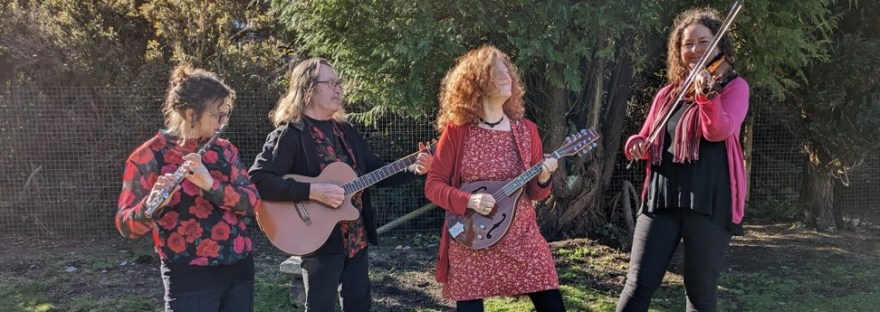
To complement the classes we’ve got two ceilidhs planned with live music from The Rosevilles Ceilidh Band – book your ceilidh tickets in advance to save money compared to on the door! The Rosevilles play a fun mixture of traditional celtic folk music, popular songs and gyspy-style swing.
We can’t wait to be dancing with you again!
Don’t miss out on the fun! Reserve your spot today!
Come along and dance to The Rosevilles Ceilidh Band on 15th July at the Carharrack Social Club. If you tried a taster class come along and have a ball to live music. If you didn’t try a class – no problem, you can pick up the dances on the night with Kate Smith calling. We look forward to a fantastic evening with you of lively, happy music and endorphin-generating dancing!
Get your tickets in advance here (£5 for adults, free entry for accompanied under 16s):
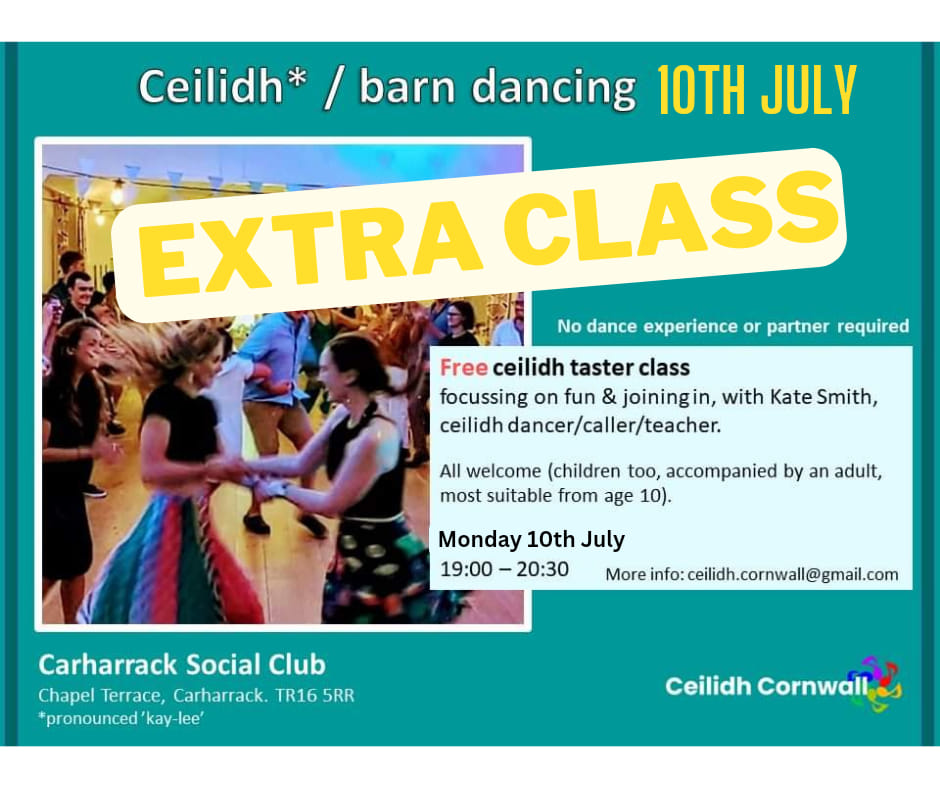
We are delighted that so many people want to try ceilidh dancing with us so we’ve added a second taster class. It is also free, and you can register using the form below. Looking forward to dancing with you.
Come dance with us – try ceilidh dancing for free on 7th July 19:00 – 20:30 at the Carharrack Social Club. I’m super-excited about all the interest in ceilidh classes from my tentative questioning last month.
Everyone welcome. Remember comfy clothes, flat-ish shoes and a water bottle.
Welcome to the new Ceilidh Cornwall website! Join our ceilidh-loving community.
Try a class, or find out more about what ceilidh is and check what’s on in Cornwall.
I’m a Scot living in Cornwall, with a love of dance. Even on the darkest, wettest winter day a good dose of ceilidh dancing can cheer the darkest mood, and an hour of ceilidh is, for me and many others, way more fun than an hour in the gym, but just as good for keeping fit.
Looking forward to meeting other ceilidh-lovers and inviting others to try it out. Smiling (virtually) guaranteed!
Do please explore this new website – it’ll expand shortly to include more information on ceilidh and ceilidh-like dancing, about this project and what we offer.









 Ceilidh Cornwall