
barn dance, Carharrack, ceilidh, classes, community, dance instructions

Ceilidh class notes (24/10/2023)

This week we danced some ceilidh classics, getting ready for a flurry of ceilidhs in the run-up to Christmas, and because lovely couple H and S are looking forward to a ceilidh at their forthcoming wedding 🙂

So, a couple of classic English ceilidh dances, and a couple of classic Scottish ones. Plus, one extra for our almost-but-not-quite-Hallowe’en class:

Lucky Seven

Lucky Seven is a classic ceilidh dance that is an excellent mixer – a progressive dance where you dance with different partners each time through the dance. The origins of the dance seem a little unclear, with some sources describing it as Welsh, others as American-Danish, others Scottish (though I never encountered it living in Scotland) and others as English-style. It is so simple that it isn’t impossible that it has evolved from a variety of origins. As with so many ceilidh dances there are many variations of this dance (circling for different numbers of steps, other figures, turning partners, do si dos, etc etc), but they all have this grand chain and counting to seven.

The key thing here is to be able to count to seven (or however many the caller asks you to count to).

Slightly chaotic version!

Lucky Seven has a fragment of a ‘grand chain’ figure, a move that I really love because when it works well it really flows very nicely. In a grand chain you face your partner – shake or take their right hand and ‘pull’ them passed you, then give your left hand to the next person, pull them passed you, then right for the next person etc etc. Count your partner as person 1, then keep going until you reach person number 7 The key to making it work is knowing which direction to head around the circle when you start the grand chain – you start facing your partner, so if you are on the left of your pair then you will head anti-clockwise around the circle, right of your pair, then you head off clockwise. Person number 7 you spin instead of passing – so after spinning making you sure you end up on the left or right of your new partner, just as you were arranged before, back into the circle to start the dance again.

When it doesn’t quite work there is chaos! Usually this is because of either, instead of passing your partner or people in the circle you’ve done a complete turn and headed back the other direction, or you’ve ended up on the wrong side of your new partner after you had a spin, or perhaps after the quick spin you’ve forgotten whether the person on your right or left is your new partner and you turn to face the wrong person at the start of the grand chain. Easily done – the spin is a bit disorientating. Don’t worry about chaos – if you find yourself partner-less just head to the centre of the circle and you’ll find anyone else who is lost. If you are lost there must be at least one other person who is also lost.

Often, once you’ve got the dance a caller might change the number of people you pass on your grand chain, so you need to keep one ear open to the instructions from the caller.

Dashing White Sergeant

Extremely popular at ceilidhs in Scotland, the Dashing White Sergeant is actually inspired by Swedish circle dances. In this dance you stay with the same set of three people and progress around the room dancing with other threes, so you meet many of the people in the room.

Ceilidh style

Don’t be put off if other sets of 3 in a ceilidh do something a bit different than your set of 3. There are quite a few variations and flourishes. Variations in the dance are usually in the section danced in threes (the reeling section).

Scottish Country Dance style is more elegant, a two-handed turn and a reel of three or figure of eight move (where the dancers trace a shape on the floor). Sometimes you’ll see this figure of eight at ceilidhs also, but rarely the double handed turn.

Scottish Country Dance style

Reelers do their fancy turns and add claps in between setting and turning:

Reeling style

Witches’ Reel

In light of this being our class just before Hallowe’en it seemed important to include this one. A very easy longways set dance with a ‘thread the needle’ figure – see the video below for an illustration.

Gay Gordons

A couple / sequence dance classic at ceilidhs is the Gay Gordons. It is considered a traditional dance across multiple countries. This video below outlining the steps and the specific ‘Gay Gordons’ hold is very clear:

And here it is in action:

Oxo Reel

The OXO reel is an English ceilidh dance which is one I’ve picked up in recent years, and I really like the way it starts (so I have ‘borrowed’ that move for my dance Jonny’s birthday reel). OXO is the figure to remember here, and keep an eye out for where you are in the set to know what to do each time around: in a set of 6 couples he top and bottom 2 couples circle left for 8 then right for 8 and the middle couple make right- then left-hand stars. Where numbers of dancers can’t make a set of 6 couples callers may vary the instructions for the OXO bit. This dance is on the repertoire of many English ceilidhs so a very good one to know.

Glossary

Grand chain: In a grand chain, usually in a circle, half the dancers travel clockwise around the set and the others anti-clockwise, alternately taking right then left hands with the person in front of them and passing them on to the next person in the circle. Start facing your partner and take their right hand to start, then keep moving around the circle in the same direction. Here, below, is a very formal demonstration of a grand chain, from Scottish Country Dancing. It is a good illustration of the movement dancers make around the circle.

Grand chain demonstrated for Scottish Country Dancing

Progressive: A progressive dance is where you change partners at the end of each repeat of the dance.

Thread the needle: In a longways set, all join hands on the sides of the set and across the bottom of the set, then the person at the band end of one of the sides followed by the others dances through an arch made by 1st and 2nd people in the other line. Usually this is repeated – one line leads first (traditionally women) then the second line repeats.

This dance video starts with the ‘thread the needle’ move, in a dance of the same name:

Thread the needle
barn dance, Carharrack, ceilidh, classes, community, dance instructions, Uncategorized

Ceilidh class notes (10/10/23)

The class this week was focussed on setting steps – or pas de basque.

Circassian Circle (non-progressive)

To warm up we danced a Circassian Circle Scottish ceilidh dance, setting to our partners and promenading around the circle. It is an easy dance, one we adapt to add in new figures or steps and it gets us warmed up.

Not to be confused by the Circassian Circle Scottish Country Dance which is entirely different!

How did two dances that appear very different get the same name? Originally the Circassian Circle was a dance of multiple parts – the Scottish Country Dance version was originally part 1, and the ceilidh version was part 2 or 3. The ceilidh version is now the most commonly seen. John & Karen Sweeney’s Contrafusion website discusses this quirk.

So popular – two circles – the caller says “all the posh folk into the inside”! Also, see this version from Edinburgh which is the same as the version we’ve done in class.

Circassian? What is Circassian about the Scottish dance? Not clear! Circassia was a small nation on the northeastern shore of the Black Sea, until 1864, after which time it was conquered and occupied by Russia. Most of the Circassians that survived were exiled and the Circassian diaspora is now spread around the world. Perhaps this explains why there are very similar folk dances in many different countries.

A very similar German dance (Fröhlicher Kreis – Happy Circle)

The Reel of the 51st Division

Whereas at last class we danced Strip the Willow, to practice spinning (it is all about spinning), this time we danced the Scottish Country Dance Reel of the 51st Division to practice setting – there is a lot of it in this dance.

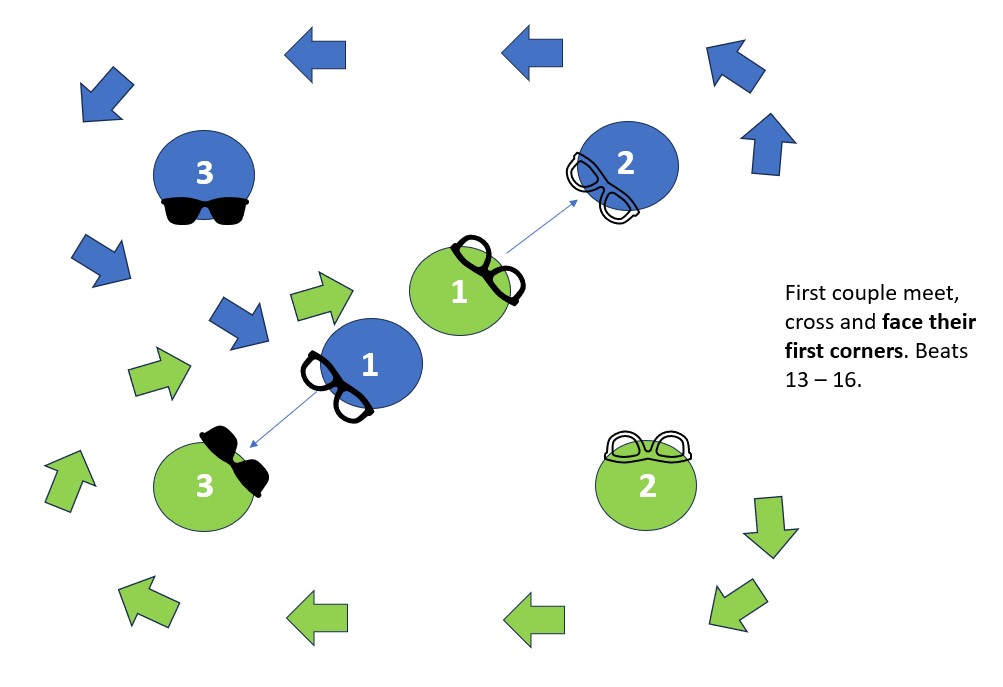
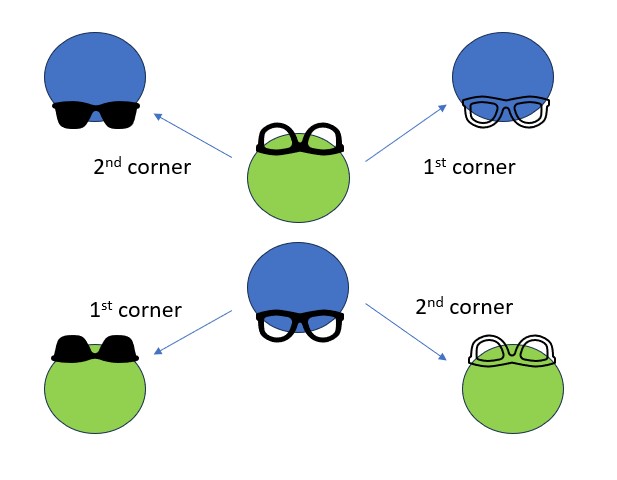
The trickiest aspect of this dance is ‘corners’ (see glossary below)- after initially setting to each other (also see the glossary) the active couple casts to the bottom of the set and then moves to face their ‘first corner’, dances with them, then turns to face their ‘second corner’ and repeats the moves of the dance with them. When both the active dancers face their first corners (and then later their second corners) they form a diagonal line of dancers across the set.

Beats 1 – 12:

Beats 13 – 16:

A video makes this clearer:

Here, danced in the Scottish Country Dance style with 6 dancing in a set of 8. See also Robbie Shepherd’s explanation of the dance with annotations over the video.

The dance is most often done in a set of 4 pairs (or couples), but has been adapted for 3 pairs (one version here, and another here – the difference being where the active couple goes at the end of each time of the dance – see ‘dance notes’ on these links).

In June 1940 after the fall of Dunkirk, over 180,000 British soldiers were left in France – including 10,000 soldiers of the 51st Highland Division captured on the Normandy coast after brutal fighting. Following their forced march to captivity deep within Germany, over the next five years the men plotted to survive and escape. To keep up moral, three officers devised a new Scottish country dance based on the insignia of the St Andrews Cross [the Scottish flag, the Saltire]. The reel quickly spread to other camps, and when the men tried to send details of the dance steps home on Red Cross cards to their families, their German captors were convinced they were trying to communicate in secret code. It was only when the men were released at the end of the war and reunited in Scotland with their wives, mothers, sisters and girlfriends could the whole dance be pieced together.” (BBC “Picture This” documentary description).

Britannia Two Step (progressive)

An easy three-person dance, quick to pick up, and a bit of light relief! Starting on the left foot!

Watch how some sets on each side of the room say ‘hi’ by joining hands at the start of the dance after heel toe and step to the left into the middle of the room, a sweet friendly touch.

Now we’ve master travelling steps, turns and setting, we’ll be all ready for The Dashing White Sergeant in our next class. Looking forward to dancing with you next time.

Glossary

Setting step, or pas de basque – used for dancing on the spot, or for only a small amount of ‘travelling’. To set means to dance a pas de basque in one direction and then the other.

Family tutorial, building up the pas de basque setting steps from walking to full speed.

Corners – In a longways set, to find your corner: your corner dancers are in the line facing you before you start the dance, never in the same line as you. Once positioned between the two lines standing back to back with your partner and facing the ‘other’ line from the one you belong to, your first corner is diagonally to your right and your second corner is diagonally to your left.

Carharrack, classes

Autumn ceilidh classes and ceilidh evenings

Ceilidh dancing is a fabulous way to keep fit, have fun and meet people. Come and join us at the Carharrack Social Club for ceilidh classes and ceilidh evenings this autumn – we’ve got dates now for the rest of 2023!

Ceilidh dancing is a modern folk dance tradition popular in Scotland, and more recently across England. Similar dances can be found in Cornwall at nos lowen events. Our classes are suitable for those entirely new to dancing and ceilidh, as well as the experienced ceilidh dancer. You will learn classic ceilidh dances from Scotland and England and their associated steps and sequences, as well as more unusual dances from the ceilidh repertoire, and other ceilidh-like folk dances from traditions across the UK, Europe and North America. We’ll use recorded music in class, which allows us to explore an eclectic range of styles and bands.

You can drop in (pay by cash or card) or pre-book classes to secure your place, and if you block book for the term then you’ll get one class for free.

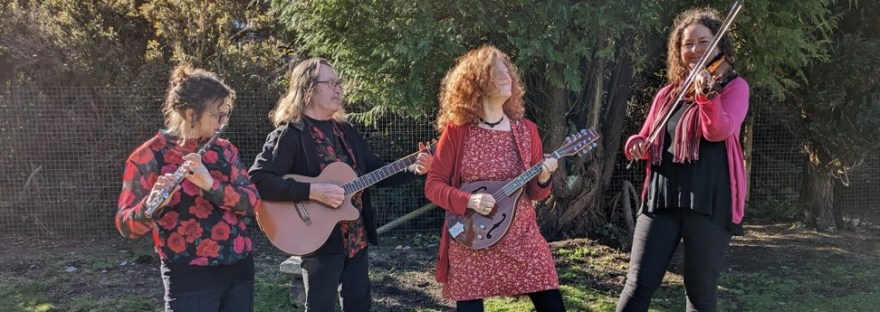
To complement the classes we’ve got two ceilidhs planned with live music from The Rosevilles Ceilidh Band – book your ceilidh tickets in advance to save money compared to on the door! The Rosevilles play a fun mixture of traditional celtic folk music, popular songs and gyspy-style swing.

We can’t wait to be dancing with you again!

Don’t miss out on the fun! Reserve your spot today!

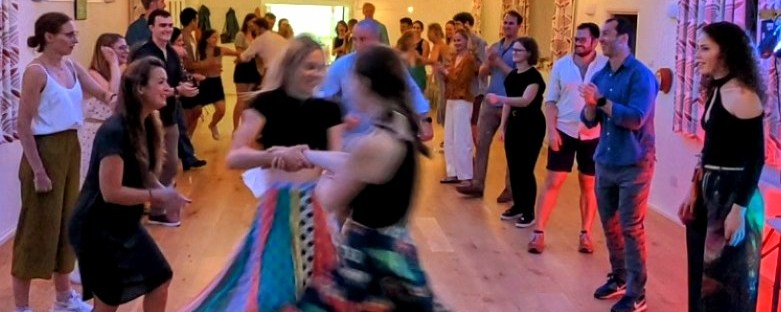
Photo credits: Top: Anete Lusina on Pexels.com; Bottom: Kate Smith, Birthday party ceilidh with The Rosevilles, July 2023

Carharrack, ceilidh, dance night

Ceilidh with The Rosevilles, 15th July

Come along and dance to The Rosevilles Ceilidh Band on 15th July at the Carharrack Social Club. If you tried a taster class come along and have a ball to live music. If you didn’t try a class – no problem, you can pick up the dances on the night with Kate Smith calling. We look forward to a fantastic evening with you of lively, happy music and endorphin-generating dancing!

Get your tickets in advance here (£5 for adults, free entry for accompanied under 16s):

Carharrack, classes, community, free, taster

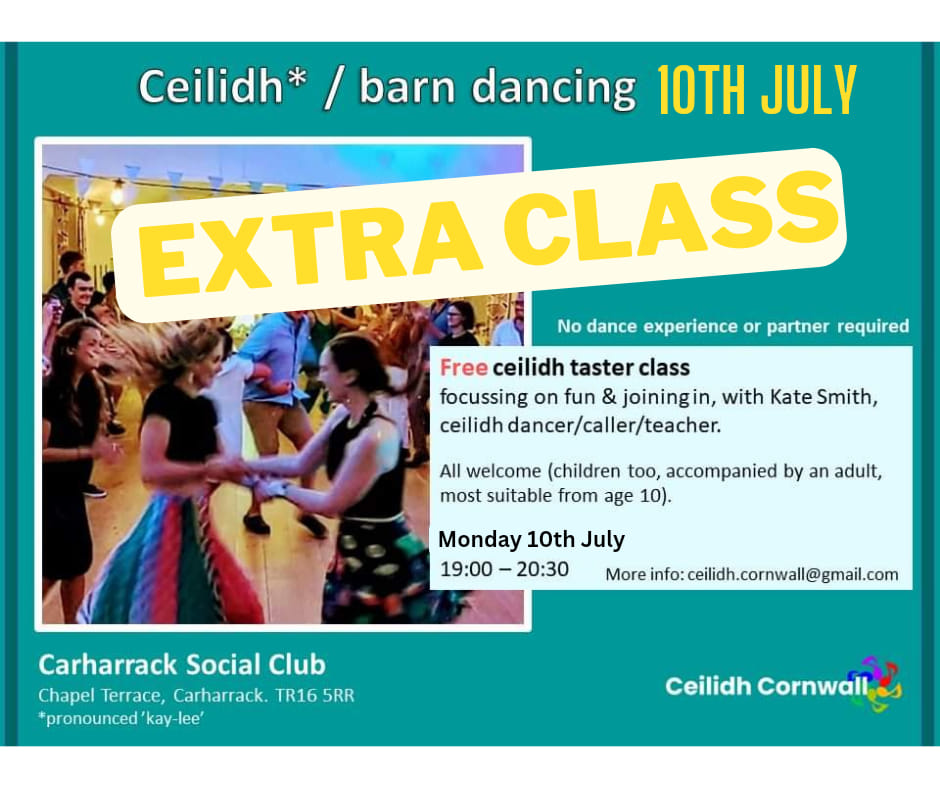
So many people fancy trying ceilidh – extra class added, 10th July!

We are delighted that so many people want to try ceilidh dancing with us so we’ve added a second taster class. It is also free, and you can register using the form below. Looking forward to dancing with you.

Carharrack, classes, free, taster

Whoop – ceilidh taster class 7th July

Come dance with us – try ceilidh dancing for free on 7th July 19:00 – 20:30 at the Carharrack Social Club. I’m super-excited about all the interest in ceilidh classes from my tentative questioning last month.

Everyone welcome. Remember comfy clothes, flat-ish shoes and a water bottle.

ceilidh, classes, community

Hello World!

Welcome to the new Ceilidh Cornwall website! Join our ceilidh-loving community.

Try a class, or find out more about what ceilidh is and check what’s on in Cornwall.

I’m a Scot living in Cornwall, with a love of dance. Even on the darkest, wettest winter day a good dose of ceilidh dancing can cheer the darkest mood, and an hour of ceilidh is, for me and many others, way more fun than an hour in the gym, but just as good for keeping fit.

Looking forward to meeting other ceilidh-lovers and inviting others to try it out. Smiling (virtually) guaranteed!

Do please explore this new website – it’ll expand shortly to include more information on ceilidh and ceilidh-like dancing, about this project and what we offer.

Please tell your friends about Ceilidh Cornwall!