

Isn’t it lovely that we are seeing the sun, after what must be six months of rain! I’m so happy I could dance…
Perfect timing really – ceilidh classes start again on Tuesday 23rd April and we’ve got the venue booked fortnightly right through until mid December, with a teeny break in August.
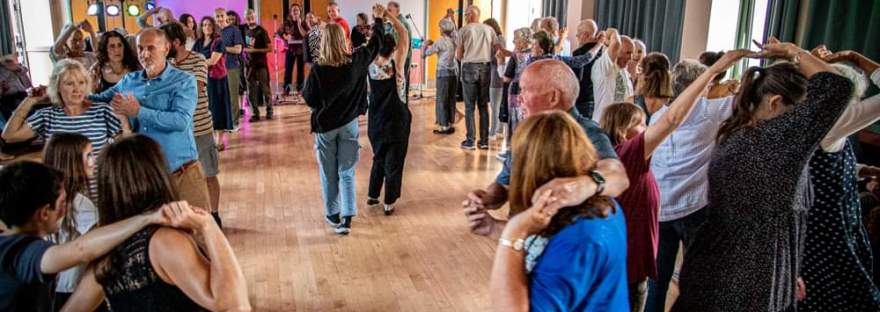
Despite being rather quiet on the website front (dratted illness, but much better now, and joyful busyness with ceilidhs and day-job work), we’ve been having fun with ceilidh classes over the winter-spring term, and have welcomed a lot of new dancers into our community. It has been lovely to see familiar and new faces enjoying themselves on a Tuesday evening.
If you fancy joining us, or tried it out during the winter but were put off because of the chilly weather, then please do feel very welcome to come back and join us. All our classes can be stand-alone, so there’s no problem if you’ve missed any or not been before. We still meet at Carharrack Social Club and classes are 19:30 – 21:00 fortnightly on Tuesdays.
So, what have classes been like during the dark and rainy winter (and spring too)?
Would you enjoy them?
Firstly, they’ve been good for getting the blood circulating and warming up chilly fingers and toes, and everything in between! We’ve had classes in storms and I was so grateful and delighted that people ventured out through the rain and wind to have a dance – thank you!
As with the first term in the autumn, our first couple of classes were very full in January, with people keen to try out this ceilidh thing, over 40 people each time. Then, as things settled down a bit we’ve had around 24 people at most classes since then (not always the same people, but there are some regulars and often a few people who are just trying it out).
We’ve learned a few ceilidh classics and some less well know dances, as well as few from beyond our shores.
Here are some dances from our classes before Easter. I’d love to know which ones people liked best.
Goathland Square Eight
A square dance, where each couple forms the side of the square, often mixed up with Holmfirth Square or other similar square dances, but quite easily interchangeable and that’s not necessarily bad. This version in the video above is fun – crossing the set with arches like this and grand chains around the circle are fun (alternating right and left hands with other dancers as you move around the set – you go one way, your partner goes the other way, you meet half way and then again where you started out – potentially very civilised, like shaking hands with everyone in the group in turn (haha, maybe not, this is ceilidh, potential for chaos). There are several dances with ‘Square Eight’ in the name, prefixed by different locations, e.g. Cumberland Square Eight, Yorkshire Square Eight. They are usually fun, and square eight just tells you how many people are needed and what shape to start out in. We sometimes like to play around with numbers and shapes though, so everyone can join in.
Country Bumpkin
A relatively modern dance with an interesting variation of a grand chain, the horseshoe grand chain (‘trousers’ – up one leg and down the other!) rather than a circle, written by Mike Barraclough in 1982.
Old Swan Gallop
Any dance where you can gallop and infiltrate other sets is a hit! Here you start in a Sicilian Circle formation – one couple facing another couple in a minor set of 4 dancers within the wider big circle shape. This dance has evolved, as described by Lisa Heywood, but in this form was written by Dave Hunt, adapted from a dance by Roger Watson.
Circle Waltz
Beautiful, graceful and reminiscent of the elegant dances in historical dramas, I love the Circle Waltz. Also, an excellent dance to have a change of tempo and a wee bit of breather between all the jigs and reels.
Riverside Jig
Here’s one where you’ll need a breather afterwards! The Riverside Jig is a popular and easy ceilidh dance, and also fast and furious as the top two couples at the end of each time through the dance rush over the heads of all the other dancers right to the bottom of the hall. The dance is named after the famous Riverside Club in Glasgow which used to hold regular ceilidhs.
Canadian Barndance – to Salsa Celtica
My favourite! Here’s us dancing this spring at our regular Tuesday class in Carharrack. It’s fun to play around with musical genres!
Look good?
Feel most welcome to join us on a Tuesday evening at Carharrack Social Club – more details about classes can be found here.
 Ceilidh Cornwall