
It’s been a busy few weeks but I’ve been delighted by the welcome received at our ceilidh tasters. Thank you to all who came along to give this a try.
We had two classes in the first half of July, both at Carharrack Social Club (who kindly didn’t charge us for use of their function suite so that we could offer you classes for free), and we covered four dances – two from Scotland, and one each from Norway and Iceland.
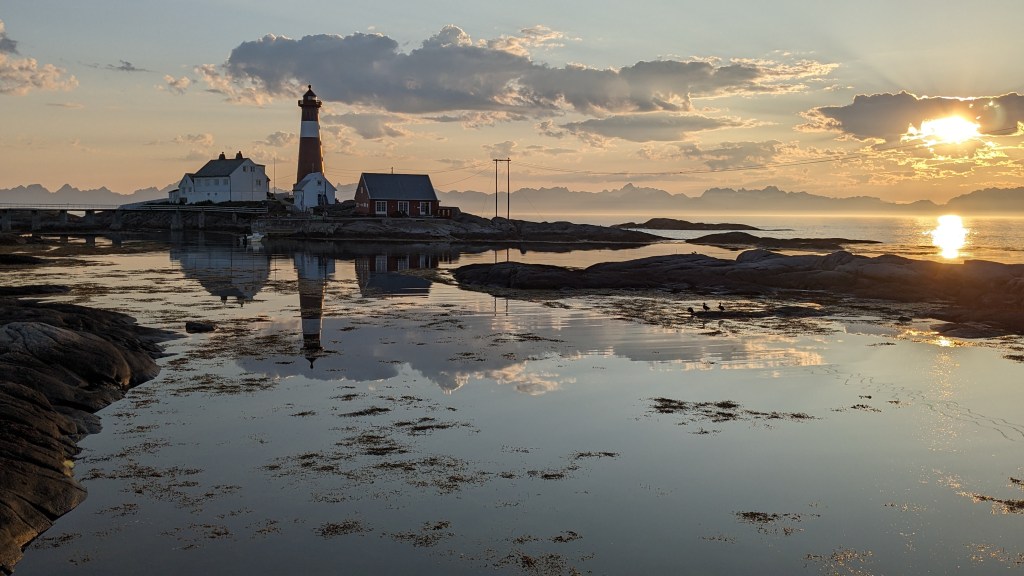
Midnight sun at Tranøy Fyr, northern Norway, June 2023
Inspired by 12 days north of the Arctic circle for my day job (I’m lucky), sitting up late with students from across Europe celebrating midsummer and chatting about our different folk traditions, I wanted to bring a little Nordic culture home and include a Norwegian dance. It was, admittedly, a little daft to include a dance we hadn’t danced much ourselves but we managed a fabulous community effort to learn it together, and I must say I do think it is a beautiful, fun dance once you get your head around it. It is called Feiar fra Vestlandet, the sweeper dance from the west country of Norway. The first half uses a sweeping step, hence the name.
Continuing our Nordic adventures, we celebrated our Ceilidh Cornwall family links to Iceland with a serpent-style introductory warm-up, dancing to a song about riding through Iceland’s remote and desolate interior landscape, Á Sprengisandi.
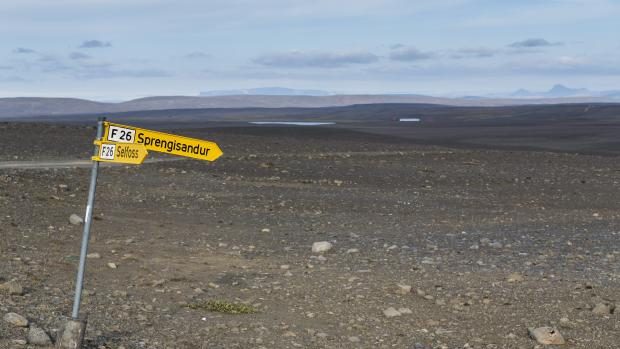
Sprengisandur, in the interior highlands of Iceland, a landscape of cold dessert, glacial deposits and ice capped mountains. Photo: Vilhelm Gunnarsson.
What I love about this is thinking of the associations this dance style has all across Europe, linking our different nations in shared and mingled cultural routes. All over Cornwall at Tea Treats and in Penzance to celebrate Golowan and Montol we find the traditional serpent dance that spirals and turns just like this one can, no need for a partner, everyone join the line. The students in Norway told me of dances they do at weddings in Bulgaria and Italy, dances in lines just like this one, the simplest being not much more than walking so that even the non-dancers feel able to join in. This chain dance style is one of the oldest in Europe, it is seen in ancient Greece circling the orchestras of early Greek theatre, and is still popular in modern Greece today. In the middle ages chain dances such as the Farandole were widely popular, including in England, France, Italy and Denmark.
At that time in Denmark these dances were danced to ballads or songs, not to music. And to this day across the Nordic countries these vikivaki dances, as they are called, are still often accompanied by singing rather than instruments. If the Icelandic lyrics seem challenging, Michael Aschauer has written English words to the same tune.
Then, back to my celtic roots, we danced some classic Scottish ceilidh: Canadian Barn Dance and the Virginia Reel! They don’t sound particularly Scottish, but yes, they are firm favourites at most Scottish ceilidhs.
The Virginia Reel has many variations that reflect it’s long and well-travelled history possibly beginning as an Irish dance called “rinnce fadha” popular in Ireland around the 4th Century A.D., then morphing into English Country dance called “Sir Roger de Coverley” before being transported to North America and Virginia where it was popular during the 18th and 19th Centuries, and regularly danced in the Appalachians into the 20th Century. Well, the Virginia Reel I learned at Burns Suppers, Weddings and student ceilidhs in Scotland was full of life in the 1980s, and is still going strong. Here is the version we covered in the class and is common at Scottish ceilidhs.
The Canadian Barn Dance, by contrast to our other dances in the taster class, is for couples (pairs) and is in the style of old time dancing, still popular at ceilidhs in Scotland, despite the ‘old time’ label. Couple dances are a more recent invention than the other dances at ceilidhs, coming to northern Europe in the 16th and 17th Centuries and spreading from the royal courts to the country over time. According to the Royal Scottish Country Dance Society the Canadian Barn Dance has been popular throughout Scotland since the late 19th Century. I can’t find anywhere that tells me why it is ‘Canadian’ (if you know why please let me know) but it is also sometimes (in books and online, though not by anyone I’ve met) called the Highland Barn Dance.
All this northern European dancing a bit too chilly for the summer? Try a Canadian band dance to Salsa Celtica’s El Sol de la Noche. Or these dances seem a bit stuck in the past? Try it out with Dua Lipa’s Dance the Night.
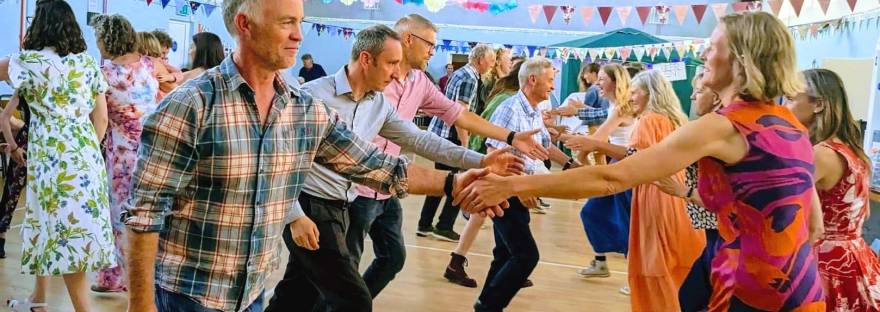
Now, I must admit that the header image to this blog isn’t from the taster classes (no bunting in class, unfortunately, though we did have fairy lights). I was way too excited and preoccupied with the class to remember to take a picture for the blog! Instead this was from a fabulous birthday party in west Cornwall with the most enthusiastic dancers, just over 36 hours after leaving northern Norway over 2200 miles away (more than twice the distance the Proclaimers were willing to go, ok I didn’t have to walk), but so worth the dash home to get back in time to see all these happy, smiling faces.
Hoping to see more smiling faces at our next classes and ceilidhs.
Our next ceilidh is tonight!!
Come and join us at the Carharrack Social Club from 19:30 – get your tickets here, or on the door. £5 adults, under 16s free.
Keep your eyes on this blog and our calendar for information about what is coming next, or sign up for our mailing list (scroll down the page) to get news straight into your inbox. Hope to dance with you soon!
 Ceilidh Cornwall