
The class this week was focussed on setting steps – or pas de basque.
Circassian Circle (non-progressive)
To warm up we danced a Circassian Circle Scottish ceilidh dance, setting to our partners and promenading around the circle. It is an easy dance, one we adapt to add in new figures or steps and it gets us warmed up.
Not to be confused by the Circassian Circle Scottish Country Dance which is entirely different!
How did two dances that appear very different get the same name? Originally the Circassian Circle was a dance of multiple parts – the Scottish Country Dance version was originally part 1, and the ceilidh version was part 2 or 3. The ceilidh version is now the most commonly seen. John & Karen Sweeney’s Contrafusion website discusses this quirk.
Circassian? What is Circassian about the Scottish dance? Not clear! Circassia was a small nation on the northeastern shore of the Black Sea, until 1864, after which time it was conquered and occupied by Russia. Most of the Circassians that survived were exiled and the Circassian diaspora is now spread around the world. Perhaps this explains why there are very similar folk dances in many different countries.
The Reel of the 51st Division
Whereas at last class we danced Strip the Willow, to practice spinning (it is all about spinning), this time we danced the Scottish Country Dance Reel of the 51st Division to practice setting – there is a lot of it in this dance.
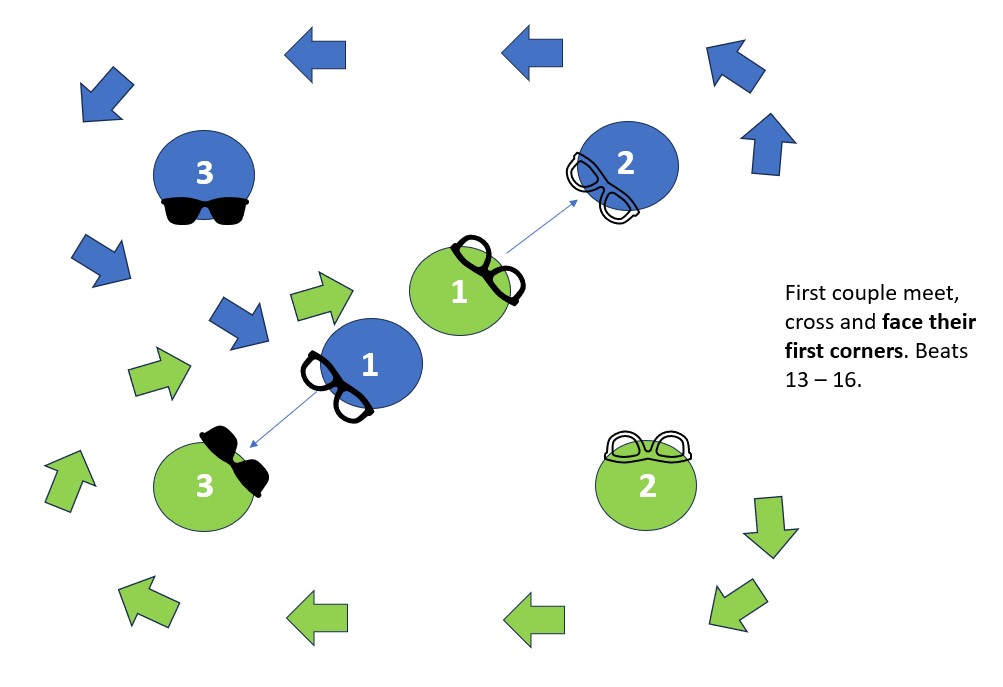
The trickiest aspect of this dance is ‘corners’ (see glossary below)- after initially setting to each other (also see the glossary) the active couple casts to the bottom of the set and then moves to face their ‘first corner’, dances with them, then turns to face their ‘second corner’ and repeats the moves of the dance with them. When both the active dancers face their first corners (and then later their second corners) they form a diagonal line of dancers across the set.
Beats 1 – 12:

Beats 13 – 16:
A video makes this clearer:
The dance is most often done in a set of 4 pairs (or couples), but has been adapted for 3 pairs (one version here, and another here – the difference being where the active couple goes at the end of each time of the dance – see ‘dance notes’ on these links).
“In June 1940 after the fall of Dunkirk, over 180,000 British soldiers were left in France – including 10,000 soldiers of the 51st Highland Division captured on the Normandy coast after brutal fighting. Following their forced march to captivity deep within Germany, over the next five years the men plotted to survive and escape. To keep up moral, three officers devised a new Scottish country dance based on the insignia of the St Andrews Cross [the Scottish flag, the Saltire]. The reel quickly spread to other camps, and when the men tried to send details of the dance steps home on Red Cross cards to their families, their German captors were convinced they were trying to communicate in secret code. It was only when the men were released at the end of the war and reunited in Scotland with their wives, mothers, sisters and girlfriends could the whole dance be pieced together.” (BBC “Picture This” documentary description).
Britannia Two Step (progressive)
An easy three-person dance, quick to pick up, and a bit of light relief! Starting on the left foot!
Now we’ve master travelling steps, turns and setting, we’ll be all ready for The Dashing White Sergeant in our next class. Looking forward to dancing with you next time.
Glossary
Setting step, or pas de basque – used for dancing on the spot, or for only a small amount of ‘travelling’. To set means to dance a pas de basque in one direction and then the other.
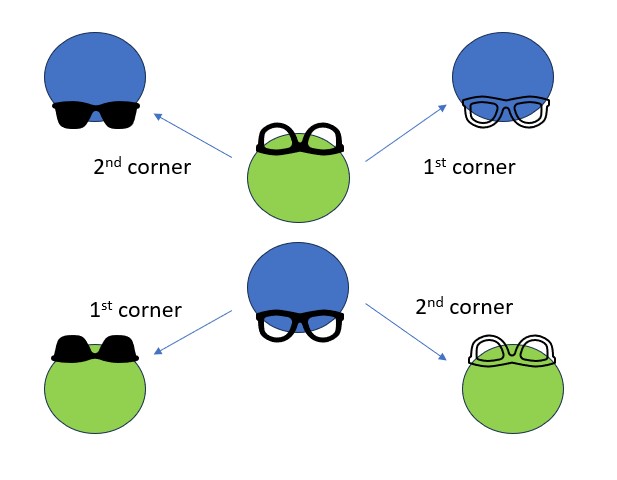
Corners – In a longways set, to find your corner: your corner dancers are in the line facing you before you start the dance, never in the same line as you. Once positioned between the two lines standing back to back with your partner and facing the ‘other’ line from the one you belong to, your first corner is diagonally to your right and your second corner is diagonally to your left.
 Ceilidh Cornwall