
A ceilidh is fantastic fun – an informal social dance, where everyone is welcome!
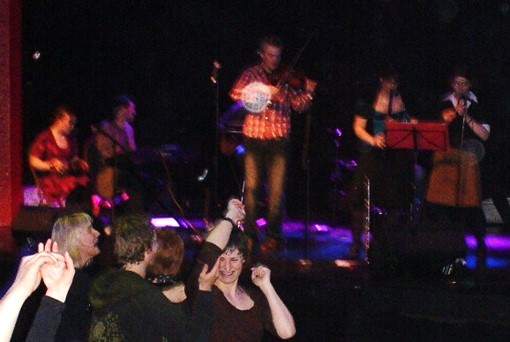
Ceilidh is a Scottish term for an event similar to a barn dance, nos lowen (Cornish), ceili (Irish), bal (European) or hoedown (American). Many countries around the world have something similar.
In Scotland ceilidhs are multi-generational with a focus on fun and joining in. Unlike some other folk dance forms it isn’t usually danced for display – this is more about having a good time and everyone participating. Traditionally a ceilidh meant a gathering, which could involve music, song and dance, but a modern ceilidh is usually a dance event with a band and very often with a caller, someone who explains how to do the dances.
There is a lively, modern ceilidh scene in Scotland that has thrown off any cloak of ‘old-fashioned’ and probably was never really considered ‘niche’. It is perfectly normal to go to a ceilidh at a wedding, a party, a celebration of any type, and most Scots learn ceilidh dancing from a young age at school and aren’t put off by it being part of PE (because it is lots of fun)!
Ceilidh is pronounced ‘kay-lee’ – handy to know
We asked google what ceilidh is, preferring to gather thoughts from multiple bands and commentators than just present our biased thoughts on how fantastic ceilidh dancing is. If it is on the internet it must be true, right? (We don’t really believe that). Here’s the outcome:

Take a look at these videos and you can judge for yourself:
Or, even better come along to a class, workshop or ceilidh with a live band.
The dances
The dances include dances for pairs or couples, and group dances, usually danced in a longwise set with two lines of dancers facing each other, or in a circle, though other formats exist too.
We love folk dance from all over the world, not just Scottish ceilidh, so you might find dances from the rest of the UK, Europe, Scandinavia, USA and elsewhere in our classes and dance events, and we are always open to learning new dances too. It is also fascinating how dances have travelled the world and morphed into different cultures, just like words and other customs move around the world. If you are into history or languages there are vast worm holes to get lost in if you think about the evolution of folk dance and ceilidh-like dancing.
The music
Modern ceilidh bands have really helped to keep the Scottish ceilidh scene alive, mixing traditional music with all sorts of other genres. You can dance to the traditional accordion and fiddle, or rock guitar and reggae beats, and everything in between.
Thinking of hiring a band – be sure to listen to them beforehand, because there is no standard ‘ceilidh band sound’.
Ceilidh Cornwall
Ceilidh Cornwall is about building community, sharing the love of dance, and promoting ceilidh dancing in Cornwall. We’d love for you to join us, the more dancers the merrier.
 Ceilidh Cornwall