
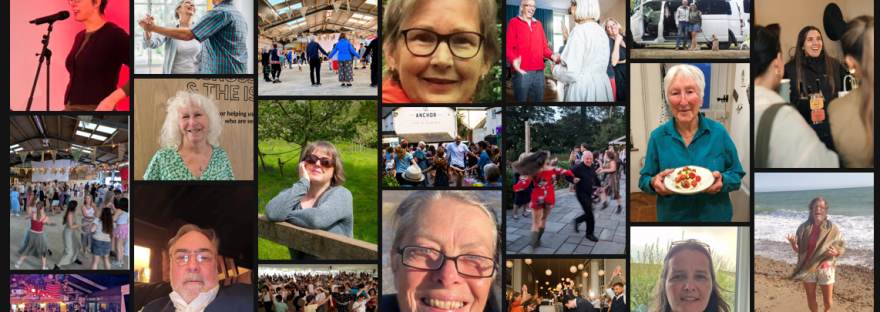
Today is European Folk Day, and I’m delighted to share a project I’ve been quietly working on: Why Do We Dance?, a collection of stories from people who ceilidh dance.
I love ceilidh dancing. I may be a little biased.
But one of the things that has always intrigued me is that I can’t spot a ‘ceilidh type’.
I couldn’t look at a group of people and tell you who would give it a go, who would love it, or who would still be dancing years later.
We spend a lot of our lives in our own little bubbles, mixing with people a bit like ourselves. On a ceilidh dance floor, I see all sorts of people dancing together.
And that made me curious.
What brought them there? What made them stay? And what did dancing mean to them?
So I asked.
The people behind the dancing
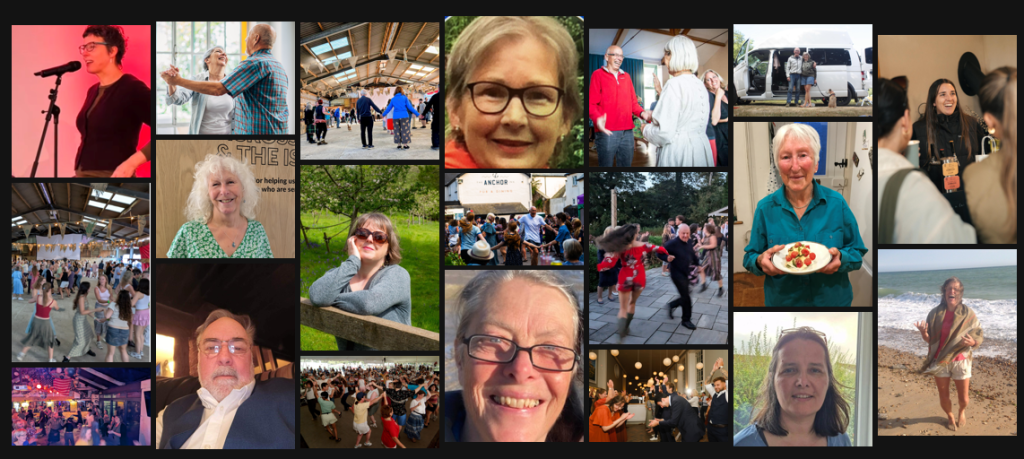
The people in Why Do We Dance? have all found their way to ceilidh dancing by different routes.
Some have been dancing for decades. Others have only recently discovered it. Some came because they wanted exercise or company. Some were persuaded by friends. Some were nervous about walking through the door.
Amelia is one of the younger people in the collection. She really didn’t want to go to her first ceilidh. It was a Tuesday night, she wanted to go to bed, and she’d gone along with friends. Then she discovered she loved it. She talks about the joy of dancing with people of all ages, having a night out that doesn’t have to revolve around drinking, and feeling more connected to the community around her.
Their stories include bereavement, illness and difficult periods in people’s lives, but also an enormous amount of laughter, friendship and joy.
There are people who talk about the satisfaction of learning and mastering dances. Others remember getting things spectacularly wrong and laughing about it.
There are people who came on their own and found themselves dancing with strangers. People who’ve discovered they are capable of things they weren’t sure they could do. People who’ve returned to dancing after many years.
And there are some wonderful love stories in there too.
Mike introduced Trudy to her first ceilidh at Sidmouth on their first date 18 years ago. They’re still dancing together.
Claire remembers dancing with her husband when they were young and energetic, spinning until they were dizzy with laughter. Now in her early 70s, she is dancing regularly again.
And sometimes what matters is precisely that a dance doesn’t belong to an earlier part of someone’s life. One contributor, who has chosen to remain anonymous, found ceilidh after the death of his partner. It was something new: something that belonged to the present rather than the past.
They’re very different stories.
That’s exactly why I wanted to collect them.
Everyone can be a dancer
I didn’t want to write something telling people why I think ceilidh dancing is good for them.
I wanted the people on the dance floor to tell me what it means to them.
For some, it’s the music. For others, it’s the movement, the people, the challenge, the laughter or the chance to switch off from everything else for a while.
Often it’s several of those things at once.
And while ceilidh can be wonderfully accessible when you’re completely new to it, there’s also enormous pleasure in getting better at dancing. There’s a particular exhilaration when you know a dance, the musicians are flying, everyone around you knows what’s coming next and suddenly the whole thing just works.
That’s one of the things I love about it.
But getting something wrong shouldn’t mean feeling that you don’t belong on the dance floor either.
Everyone can be a dancer.
Why publish it on European Folk Day?
European Folk Day is a celebration of the living traditions that people across Europe take part in, share and pass on.
That seemed like a very good day to celebrate the people who are actually out there dancing.
Folk traditions survive because people do them. They learn them, teach them, play the music, change things, bring friends, turn up to classes, organise events and step onto dance floors.
And, most importantly, they enjoy them.
Read Why Do We Dance?
You can now read the complete Why Do We Dance? collection here:
A huge thank you to everyone who contributed a story and trusted me to share it. I’ve tried to keep each person’s voice at the heart of their contribution, because these are their stories rather than mine. Although I have added one of my own at the end.
And I hope this isn’t really the end of the project.
I’d love Why Do We Dance? to become a growing collection. If you ceilidh dance and reading these stories makes you think, “I’ve got a story too,” please get in touch.
I’d love to hear why you dance.
Happy European Folk Day.

